Burglaries in Belgium: how to prevent them (without breaking the bank)
35,438 burglaries were recorded in Belgium in 2025. That's 7% fewer than in 2024, which is rather good news on paper. Except that the federal police themselves acknowledge in their latest Security Monitor that around 66% of attempts and 30% of burglaries actually committed are never even reported to the police. The real figure is therefore considerably higher than the official statistics suggest.
We often discuss this with our customers: many think a substantial budget is needed to protect themselves properly. That's not true. The vast majority of burglaries are committed by people in a hurry looking for an opportunity, not by professionals determined to get in at any cost. This means that a few good habits, combined with two or three inexpensive but well-chosen devices, are already enough to scare most of them off.
How a burglar chooses a target
We often picture a burglar as someone who plans the job for weeks. In reality, in most cases, it's someone who spots an opportunity in a few seconds while passing down a street: a house that looks empty, a window left ajar, post overflowing from the letterbox, no lights on even though it's already dark. Scouting rarely takes more than a minute, and if something seems too risky or too time-consuming, they simply move on to the next house.
That's the whole logic of prevention: it isn't about making your home completely impregnable – nobody really manages that – but about making it deterrent enough that it's no longer the easiest target on the street.
Free habits that already make a big difference
Before even thinking about buying anything, there's a whole series of good habits that cost nothing and that the police recommend first and foremost. Always close doors and windows, even for five minutes, even on the ground floor. Never leave a key under the doormat or in a flowerpot – it's one of the very first places people look. Give the impression that someone is home when you're away, with a timer-controlled light or a radio playing in the background. Avoid announcing your holiday on social media before you're back, and ask a trusted neighbour to collect the post and open the shutters from time to time.
There are also details that are easily forgotten: don't leave valuables in plain view from the street, put away ladders and garden tools that could be used to force an entry, and keep an inventory of your valuables somewhere, with photos and serial numbers, just in case. And then there's the good old neighbourhood reflex: a street where residents know each other a little and flag suspicious comings and goings is still one of the best forms of protection there is. Note too that every police zone in Belgium offers the services of a burglary prevention adviser free of charge, who can visit your home to assess its weak points at no cost.
Protecting yourself without breaking the bank: where to start
Once good habits are in place, a few low-cost devices let you go a step further. There's no need to buy everything at once; you can quite easily move forward in stages according to your budget.
For less than €20
A security plate for the door cylinder, often the weakest point of a standard lock and yet one of the cheapest to reinforce. Stickers or a small sign indicating the presence of a security system, even a basic one, which are already enough to make many opportunistic burglars hesitate. A lockable window handle, particularly useful on the ground floor.
Between €20 and €80
An outdoor light with a motion sensor, still one of the best value-for-money options there is: nobody likes to be suddenly lit up in the middle of a break-in attempt. One or two standalone door or window alarms, which run on batteries and can be fitted in a few minutes with no wiring or professional installation.
From €80-100
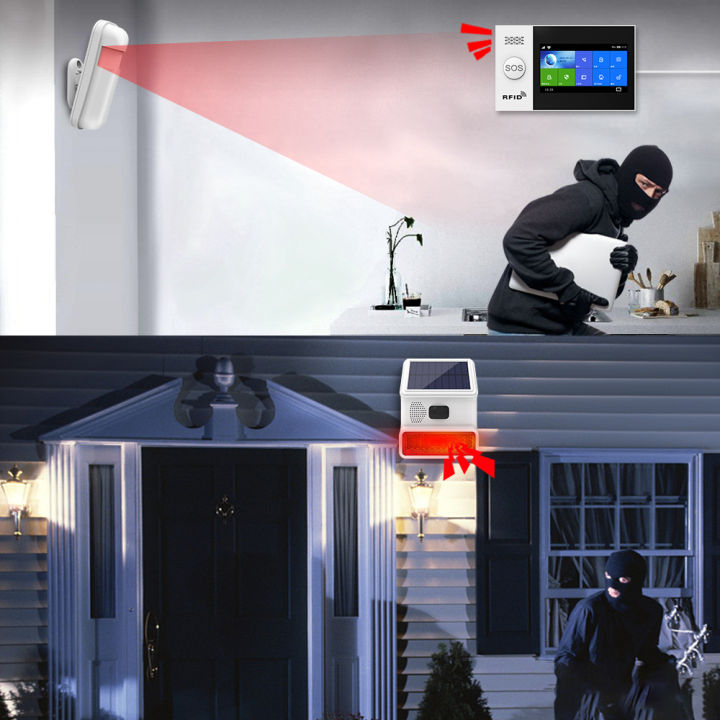
A small wireless connected alarm kit, with one or two detectors and notifications sent straight to your phone. It's the first real step towards a complete system, without requiring a subscription or an installer.
The time of year to be extra vigilant
Every year, the federal police point it out: the switch to winter time at the end of October coincides with a clear peak in burglaries. The reason is simple: night suddenly falls earlier in the late afternoon, at a time when many people are still at work. Houses left in darkness from 5 pm become obvious targets for several weeks, until everyone adjusts their routines. This is precisely the period when a simple timer-controlled light makes all the difference.
Questions we are often asked
Is an alarm really enough to deter a burglar?
In most cases, yes, especially when combined with outdoor lighting and a minimum of good habits. Most burglars are looking for an easy, quick target, not a challenge.
Do I absolutely need a professional system installed by someone else?
No. Today's wireless alarms and standalone sensors are designed to be fitted yourself in a few minutes, with no drilling or wiring.
Can I start small and add to it later?
It's actually the best approach. A motion detector and a cylinder security plate already in place are worth more than a plan for a complete system postponed for lack of budget.
In conclusion
Protecting yourself against burglary in Belgium requires neither a huge budget nor turning your home into a fortress. It's above all a matter of good habits, combined with a few simple devices placed in the right spots. Start with what costs least, and add to it gradually depending on what you want to cover.
You'll find everything you need to get started, from security plates to small alarm kits, at SecuriShop. Don't hesitate to contact us if you'd like advice tailored to your home and your budget.