In just a few years, Ajax Systems has become one of the European references in wireless alarms. The catalogue now includes more than two hundred devices, which is good news for covering every need and bad news for anyone who has to choose. This guide follows the order in which decisions are actually made in the field.
1. The control panel first, always
The Hub is the brain of the system. It receives signals from all devices, decides whether to trigger the alarm, and transmits to your smartphone as well as to a monitoring station. Everything else follows from it, and it is the only component that is hard to replace once the installation is in place.
Real capacities
| Model | Devices | Users | Groups | Communication | Photo verification |
|---|---|---|---|---|---|
| Hub | 100 | 50 | 9 | Ethernet + GSM | No |
| Hub 2 | 100 | 50 | 9 | Ethernet + 2 SIM | Yes |
| Hub 2 LTE/4G | 100 | 50 | 9 | Ethernet + 2 SIM 4G | Yes |
| Hub 2 Plus | 200 | 200 | 25 | Ethernet + Wi-Fi + 2 SIM 4G | Yes |
Two figures deserve careful reading. The number of sirens and keypads is capped at 10 combined on all control panels, and the number of ReX repeaters at 5. You hit these limits well before the overall device limit.
How to decide
Apartment or house — a Hub 2 is more than enough. One hundred devices is five to ten times what a home actually uses. Don't pay for capacity you will never reach.
Shop, practice, warehouse — the Hub 2 Plus is justified on three concrete criteria. The 25 security groups versus 9 let you arm the stockroom while the shop floor stays open. Wi-Fi adds a fourth communication channel where the Hub 2 has three. And the 200 users become useful as soon as you have rotating staff.
Unreliable internet connection — choose a LTE/4G version. On the standard Hub 2, both SIMs are 2G: it works, but the 2G network is being phased out by several European operators. It is a choice for longevity rather than performance.
2. Jeweller: the Ajax radio
Jeweller is Ajax's proprietary radio protocol. It operates between 866 and 926.5 MHz depending on the region, with encryption and frequency hopping, for a stated range of up to 2,000 metres in open field. Each device communicates with the Hub at an adjustable interval of 12 to 300 seconds: a cut or jamming attempt is therefore reported within a few dozen seconds at worst.
In practice: Jeweller for everything that already exists, because drilling and running cable costs more than the equipment itself.
3. Detectors: where and how many
An alarm system is only as good as the placement of its detectors. Three well-placed ones are worth more than eight badly aimed ones.
Motion
MotionProtect is the standard infrared detector, with pet immunity. MotionCam adds a camera that sends a series of images on every alarm. This is the feature that changes everyday life: you verify the alarm from your phone instead of rushing home. MotionProtect Plus combines infrared and microwave for difficult environments — conservatory, draughty rooms, sun-exposed rooms.
Openings
DoorProtect detects opening by magnetic contact. DoorProtect Plus adds an accelerometer and a vibration sensor: it detects an attempted break-in before the opening. On a front door, it is the model to prefer.
Sizing
For a detached house, plan one motion detector per passage area on the ground floor, one opening detector on each main entry point, an outdoor siren and a keypad near the entrance. Four to six detectors provide proper coverage. For an apartment, two to three are enough.
Installation rule: at about 2.4 m high, oriented so that an intruder crosses the field rather than walking straight towards it — an infrared sensor detects crosswise movement far better. Avoid: facing a sunlit window, above a radiator, opposite an air-conditioning vent.
4. Sirens and keypads
The siren is the most underestimated element. A detected but silent intrusion lets the burglar work undisturbed. A StreetSiren on the facade works as much on visibility as on noise: many break-ins never start because the reconnaissance revealed a siren. Mount it high, above 2.5 m, on the side most exposed to the street.
As for keypads, the KeyPad covers the basic need, the KeyPad Plus adds RFID reading (faster and more discreet than typing a code in front of a witness), and the KeyPad TouchScreen displays the system status and manages groups. All include the duress code, which appears to disarm while sending a silent alert.
A commonsense point that is often overlooked: never install a keypad on an exterior facade. A keypad accessible from outside is a weakness, not a convenience. If you need to disarm before entering, use a remote or the app.
5. Obligations in Belgium
An alarm system installed in a home must be registered with the federal contact point set up for that purpose. Registration is done online, it is free, and it must be updated if the occupant or contact details change. It does not require any monitoring contract.
The operating time of an outdoor siren is also regulated. Ajax's default settings stay within the usual limits, but check the municipal regulations that apply to your address — they may be stricter.
Finally, if you use an installer, make sure they hold the FPS Interior licence required for security companies. This is a legal obligation, not a commercial label.
6. Do you need a subscription?
No. The Ajax Security System app, push notifications, remote control and event history are included, with no recurring fees. A contract is only needed to connect the installation to a professional monitoring station — which remains recommended for a business, less often for a home.
Indicative budget
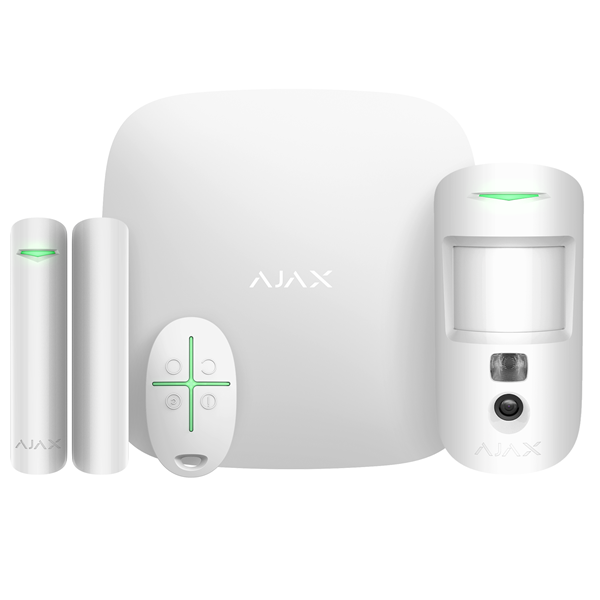
Prices include 21% VAT at the time of writing: the Ajax Hub kit (control panel, motion detector, door contact, remote) costs €373.65. The Hub 2 kit with photo verification costs €544.46, and €795.44 with a keypad and indoor siren. The Hub 2 Plus kit for businesses starts at €813.65. Then allow roughly €45 to €175 per additional device depending on the type, and €302.50 for installation by a licensed technician. The breakdown by configuration is on our page Ajax alarm in Belgium.
Frequently asked questions
Can I install it myself?
Technically yes, installation is wire-free and each device is added by QR code. For a business or a connection to a monitoring station, use a licensed company.
What happens in a power cut?
The Hub 2 has a 2 Ah Li-ion battery, the Hub 2 Plus a 3 Ah one, for about 15 hours of autonomy. Detectors run on batteries and are not affected.
What if the burglar jams the radio?
The Hub detects jamming and reports it as a technical alarm. That is precisely why the polling interval matters.
Can I change Hub later?
Yes. All Jeweller devices can be re-paired to a new control panel. You only lose the reconfiguration time.
Is Ajax compatible with cameras?
Yes, through the app's video integration, and natively with MotionCam detectors, which have their own camera.
Take action
See Ajax alarm kits · Compare control panels · Choose detectors · Ajax alarm in Belgium
Not sure about sizing? Write to us via the contact form with the floor plan and the number of entry points to cover: we validate the configuration before you order.